For B2B Software-as-a-Service (SaaS) companies, the Asia-Pacific (APAC) region represents the most significant growth frontier of the decade. By 2026, digital transformation across enterprise sectors in Southeast Asia, Japan, and Oceania is driving an unprecedented demand for cloud-native applications, real-time analytics, and collaborative software. However, scaling a SaaS platform into APAC is not as simple as spinning up a few virtual machines in a new availability zone.
Unlike North America or Europe, which benefit from contiguous landmasses and unified or semi-unified regulatory frameworks (like the GDPR), the APAC region is vastly different. It is geographically highly fragmented, separated by immense oceans, and governed by a patchwork quilt of distinct, often strict, national data sovereignty laws.
If your SaaS application suffers from high latency, frequent timeouts, or violates local data compliance laws, enterprise customers in APAC will simply churn to a local competitor. To successfully capture this market, system architects must design a robust, geographically distributed infrastructure.
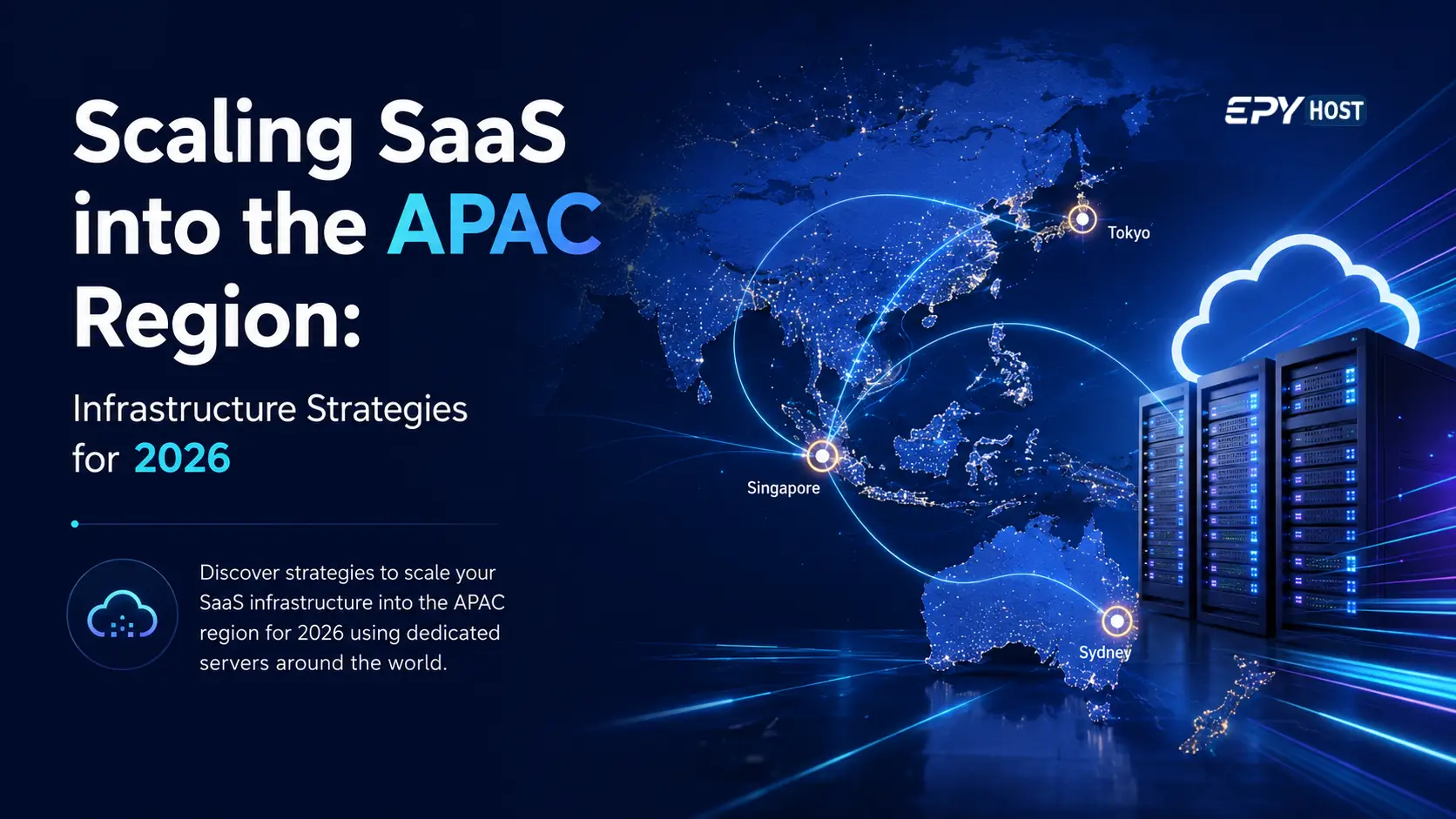
In this comprehensive guide, we will explore the architectural strategies required to scale your SaaS platform into APAC. We will answer the critical question of how to reduce latency across the Pacific, analyze the physical subsea cable routes that power the region, and explain why deploying bare metal infrastructure in Singapore, Tokyo, and Sydney is the winning strategy for 2026.
The APAC Challenge: Geography and Data Sovereignty
When North American or European SaaS companies attempt to serve APAC customers from their home data centers, the results are almost universally poor. The physical distance dictates the latency. A packet traveling from London to Singapore takes approximately 160 milliseconds round-trip. If your application requires multiple database queries or API calls to load a single dashboard, that 160ms quickly stacks into seconds of waiting time for the end user.
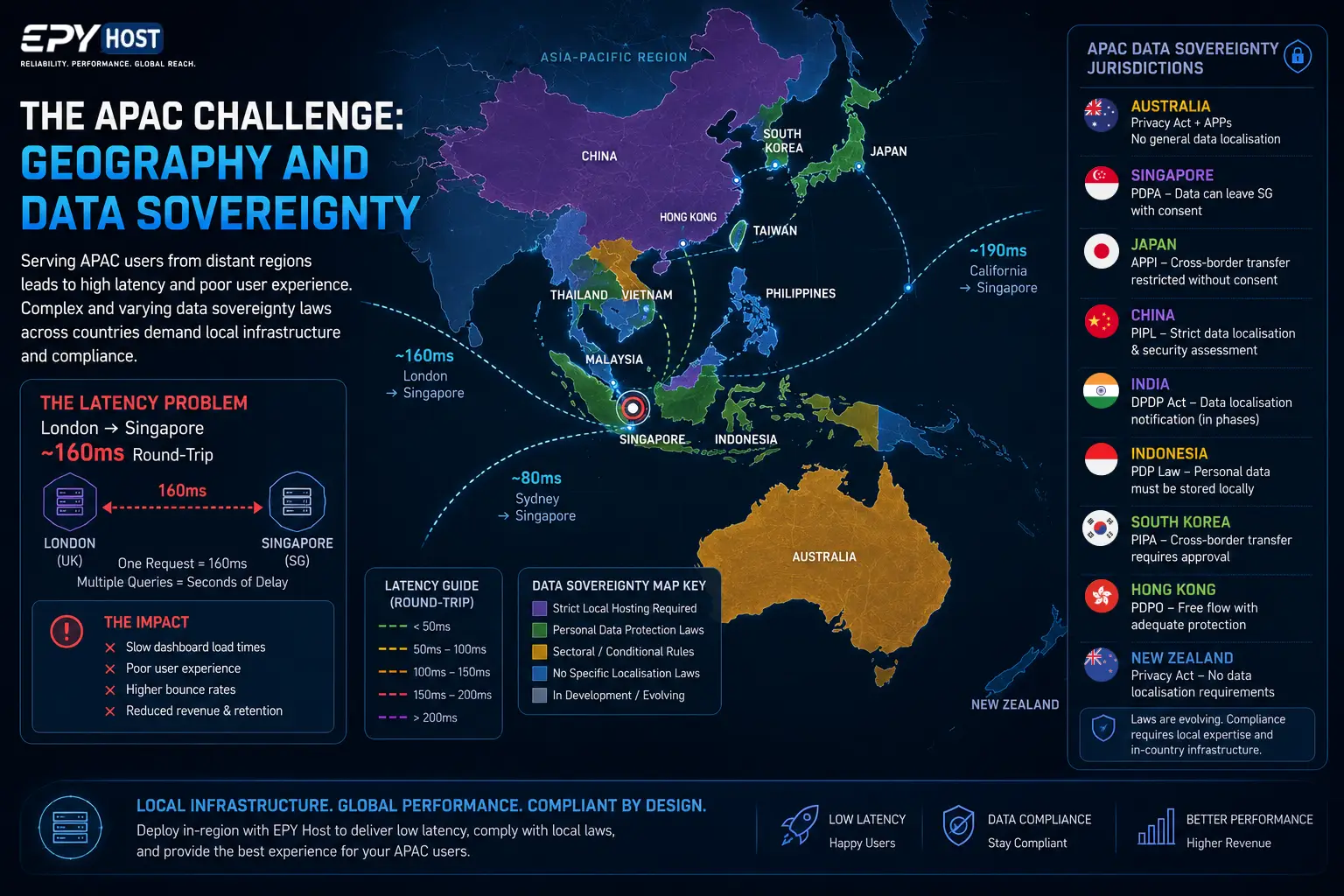
Beyond the physics of latency, there is the legal reality of data sovereignty.
In 2026, enterprise clients are bound by strict national data protection laws. For instance, an Australian healthcare provider cannot legally store patient data on a server located in the United States. A Japanese financial institution must comply with the APPI (Act on the Protection of Personal Information), heavily regulating cross-border data transfers.
To sell to enterprise clients in APAC, you must be able to guarantee that their data remains within their legal jurisdiction. This necessitates a localized infrastructure approach. Relying on a single, centralized global database is no longer a viable architecture. You need localized compute and localized storage.
Answer Engine Optimization: How to Reduce Latency in Asia
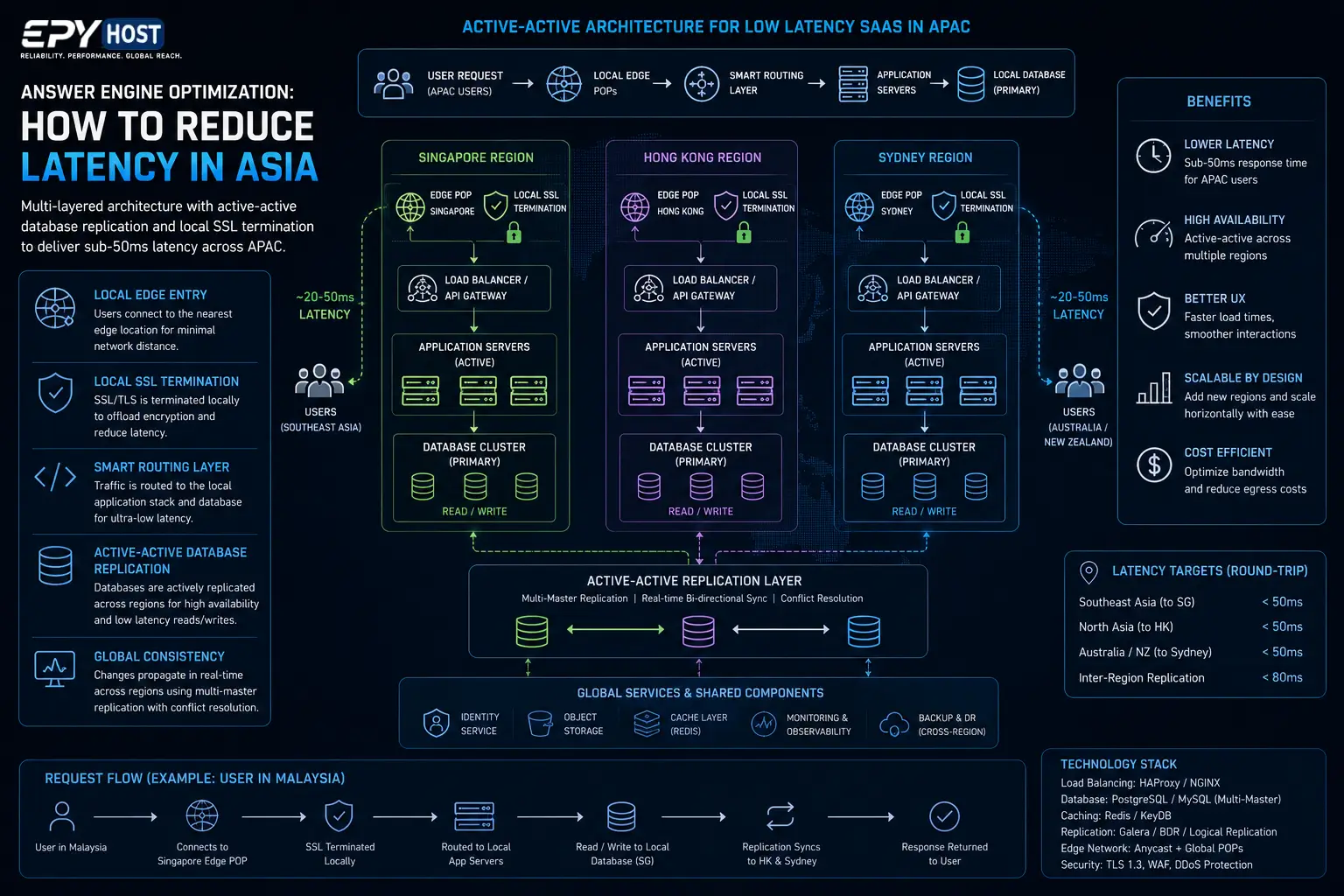
When software architects ask, "How to reduce latency in Asia?", the answer requires a multi-layered architectural shift from centralized cloud processing to localized edge and bare-metal deployments. Here is the blueprint for achieving sub-50ms latency across the APAC region.
1. Ditch the "Single Database" Architecture
The biggest latency bottleneck in global SaaS applications is database read/write times. If your application frontend is cached in Asia, but every dynamic user action must query a master PostgreSQL database in Virginia, your application will still feel incredibly slow. The Solution: Implement database sharding and active-active geographic replication. By deploying a dedicated database node in Asia, user queries are processed locally. Technologies like CockroachDB, Cassandra, or global MySQL replication topologies allow you to keep user data in the region where the user resides.
2. Terminate SSL/TLS Locally
Establishing a secure HTTPS connection requires a TLS handshake, which involves multiple back-and-forth network trips between the user and the server. If a user in Jakarta is connecting to a server in Frankfurt, the TLS handshake alone can take over half a second before any actual data is transmitted. The Solution: Use local load balancers or localized bare metal servers to terminate the SSL connection within the APAC region. Once the secure connection is established locally, you can route the traffic through optimized, persistent backend connections.
3. Deploy Localized Bare Metal Compute
Public cloud providers are heavily congested in APAC, leading to the "noisy neighbor" effect and unpredictable jitter. Furthermore, public cloud routing often takes suboptimal paths. The Solution: By deploying Asia dedicated hosting, you place your application’s core processing power right next to your regional users. Bare metal servers provide dedicated CPU cycles and RAM, ensuring that your application responds instantly without virtualization overhead, which is critical for compute-intensive SaaS features like report generation or real-time data processing.
4. Implement BGP Anycast Routing
DNS resolution can add hidden latency. If an APAC user has to query a North American DNS server to find your app's IP address, it slows down the initial connection. The Solution: Use BGP Anycast to broadcast the same IP address from multiple global locations. When a user in Asia types in your SaaS URL, the network naturally routes them to the physically closest dedicated server, instantly shaving off critical milliseconds.
The Physical Reality: APAC Subsea Cable Routes
To truly understand how to architect your network, you must understand the physical hardware of the internet. The APAC internet is entirely reliant on subsea fiber optic cables spanning the ocean floor. Understanding these routes is crucial because cable breaks (due to seismic activity or maritime accidents) are common in this region. Your infrastructure must account for redundancy.
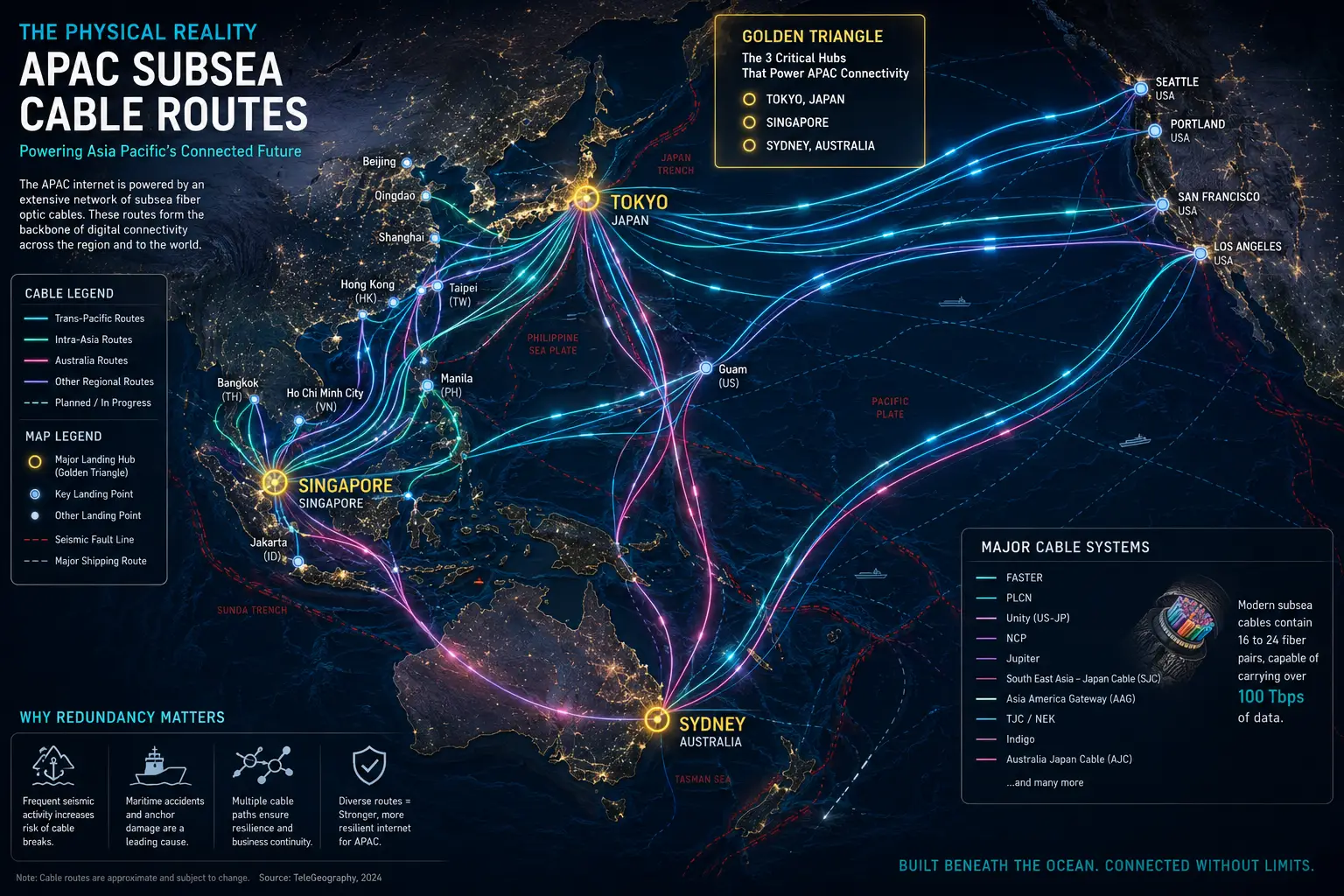
The internet traffic in APAC generally flows through a "Golden Triangle" of connectivity hubs: Japan, Singapore, and Australia.
- Trans-Pacific Routes: Data traveling from North America to Asia primarily lands in Japan. Major cables like the FASTER cable system, JUPITER, and the Pacific Light Cable Network (PLCN) connect the US West Coast directly to landing stations near Tokyo. If you are syncing data from a US master server to an Asian node, Tokyo is your fastest entry point.
- Intra-Asia Routes: Once data hits Asia, it must be distributed. The Asia Pacific Gateway (APG) and the South-East Asia Japan Cable (SJC / SJC2) are the primary arteries connecting Japan down through Taiwan, Hong Kong, Vietnam, Thailand, and ultimately terminating in Singapore.
- Oceania Routing: Australia is physically isolated from the rest of Asia. Traffic from Southeast Asia to Australia relies heavily on cable systems like INDIGO-West and the Australia-Singapore Cable (ASC), connecting Singapore directly to Perth and Sydney.
If you want true resilience in 2026, you cannot rely on just one location in Asia. A severed cable in the South China Sea can instantly add 150ms of latency as traffic is forcefully rerouted. The standard architecture for enterprise SaaS is to establish three independent infrastructure pillars within this Golden Triangle.
Pillar 1: Singapore – The Connectivity Hub of Southeast Asia
If you can only afford to deploy infrastructure in one Asian location, it must be Singapore.
Singapore is the undisputed digital capital of Southeast Asia. It serves as the primary landing point for almost all major subsea cables connecting Europe, the Middle East, India, and Australia to the rest of Asia.
Why Deploy a Singapore Dedicated Server?
Deploying a Singapore dedicated server is a strategic necessity for reaching emerging, high-growth markets like Indonesia, Malaysia, Vietnam, and the Philippines. These countries have massive, increasingly digitized populations, but their internal internet infrastructure can be highly volatile.
By hosting your SaaS application in Singapore, you bypass the unreliable local routing within those countries. Traffic hits the robust international fiber lines and reaches your server in milliseconds. For SaaS providers dealing in real-time collaboration, VoIP, or financial tech, securing the Best dedicated server Singapore provides the lowest possible latency to the highest number of users in Southeast Asia.
Furthermore, Singapore's Personal Data Protection Act (PDPA) is a recognized, business-friendly privacy framework. It provides enterprise clients with the peace of mind that their data is hosted in a legally stable and secure jurisdiction, satisfying regional data sovereignty requirements.
Pillar 2: Tokyo – The High-Tech Gateway to East Asia
While Singapore covers the South, Tokyo is your required anchor for East Asia. Japan is the world's fourth-largest economy and boasts one of the most mature, high-paying B2B enterprise markets on the planet.
The Strategic Value of a Japan Dedicated Server
Deploying a Japan dedicated server directly within the country is often a hard requirement for passing enterprise procurement and compliance audits under Japan's APPI regulations.
Additionally, Tokyo serves as the primary peering point for Trans-Pacific traffic. If your SaaS platform requires heavy, continuous data synchronization with your North American headquarters (such as machine learning model updates or global logging), a Tokyo dedicated server provides the fattest, fastest pipe directly to the US West Coast.
Hosting in Tokyo also provides excellent, sub-40ms latency to users in South Korea and Taiwan, capturing two additional highly developed enterprise markets without needing physical hardware in those specific countries.
Pillar 3: Sydney – Overcoming the "Tyranny of Distance"
The final pillar of the APAC expansion strategy is Oceania. Australia and New Zealand represent a highly lucrative market for B2B SaaS, with massive adoption of cloud technologies. However, they suffer from what network engineers call the "tyranny of distance."
Even on the fastest fiber optic cables (like the ASC), the physical distance between Singapore and Sydney introduces a minimum of 90 to 110 milliseconds of round-trip latency. For an Australian user, accessing a web application hosted in Singapore feels sluggish; accessing one hosted in the US or Europe feels broken.
Establishing an Australia Dedicated Server
To capture the ANZ (Australia and New Zealand) market, localized infrastructure is mandatory. Deploying an Australia dedicated server in Sydney provides your local users with instantaneous, sub-20ms response times.
From a legal perspective, Australia has enacted stringent amendments to the Privacy Act and the Security of Critical Infrastructure (SOCI) Act. If your SaaS software deals with healthcare, government contracts, or financial data, keeping Australian data on Australian soil via Sydney dedicated hosting is the only way to remain legally compliant. Sydney is the premier location for this hardware, as it houses the majority of the country's data centers and peering points, serving as the central hub for the entire continent.
Hardware Strategy: Why AMD EPYC is the Standard for SaaS
We have established where your servers need to be. Now we must address what those servers should be.
Modern SaaS applications are rarely monolithic. They are built on microservices architectures, utilizing container orchestration platforms like Kubernetes or Docker. To run these environments efficiently at an enterprise scale, you need massive computational density. You need to run dozens, or hundreds, of concurrent containers on a single piece of hardware to maximize your ROI.
This is why, in 2026, the AMD EPYC processor lineup has become the gold standard for dedicated SaaS infrastructure.
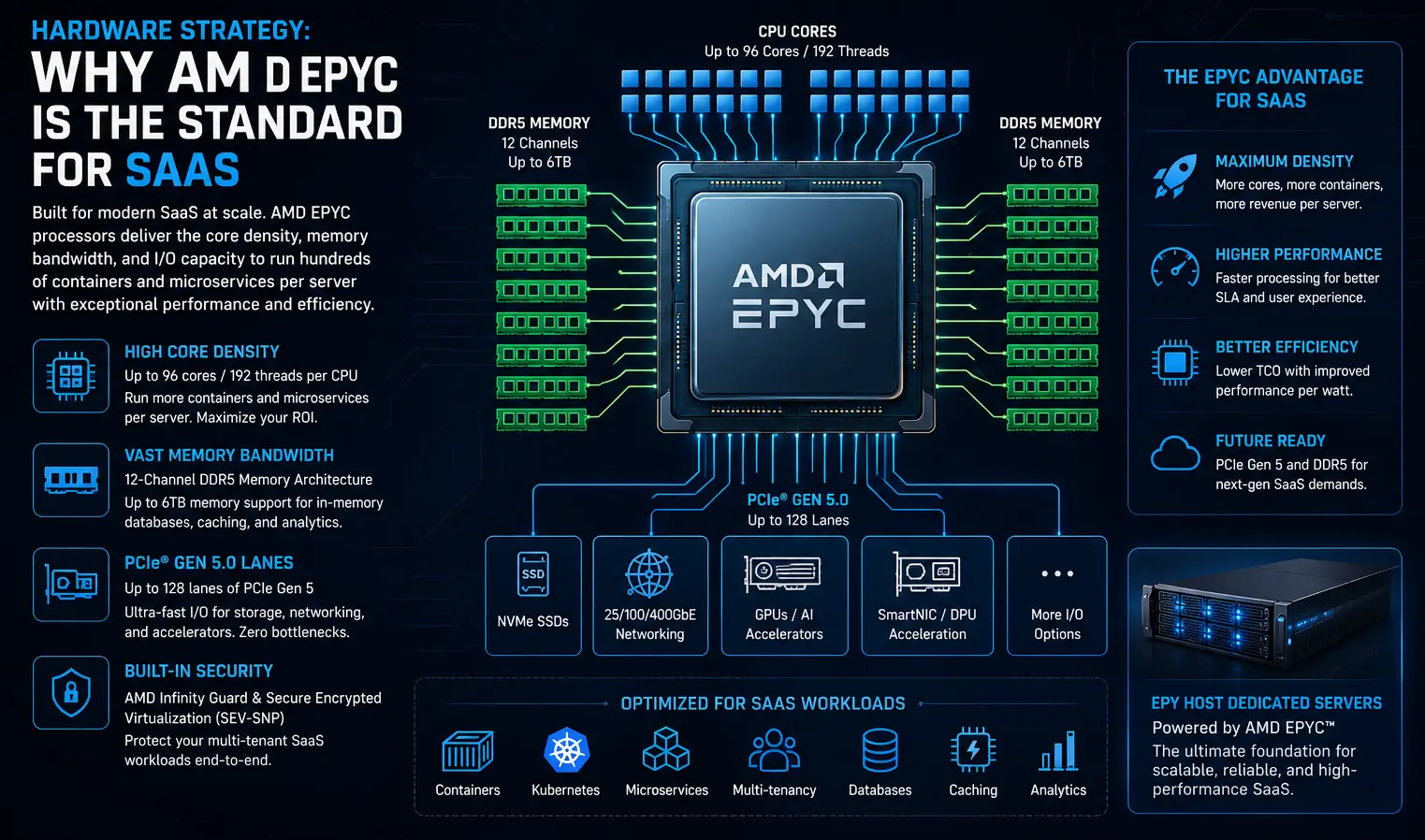
- 1. Unrivaled Core Density for Microservices: SaaS platforms thrive on multithreading. Every API request, background worker, and database query requires CPU threads. AMD EPYC server types offer massive core and thread counts (often ranging from 64, 96, up to 128 physical cores per socket). This unparalleled density allows you to pack hundreds of microservices onto a single bare metal server without suffering CPU contention or context-switching bottlenecks.
- 2. Massive Memory Bandwidth for Databases: Database nodes—the backbone of your regional architecture—are constrained by memory bandwidth. They need to load massive datasets into RAM to perform quick queries. AMD EPYC architecture features class-leading memory channel support (up to 12 channels of DDR5 memory). This allows your localized PostgreSQL or MongoDB databases in Singapore or Tokyo to execute complex queries and analytics at blinding speeds.
- 3. I/O Superiority for Edge Caching: To serve static assets, application frontend code, and user uploads quickly, your servers need fast storage. AMD EPYC platforms lead the industry in PCIe Gen 5 lane availability. This allows you to stack multiple NVMe solid-state drives in a single server, creating massive, lightning-fast edge caches that saturate your 10Gbps network uplinks, ensuring your users receive their data instantly.
Conclusion: Architecting for APAC Success
Scaling a SaaS platform into the APAC region is a complex undertaking that requires a strategic departure from centralized cloud hosting. As we move deeper into 2026, user expectations for speed are higher than ever, and governmental regulations surrounding data privacy are stricter than ever.
To successfully expand your B2B software into this lucrative market, you must embrace a localized, bare-metal strategy.
- Reduce Latency: Bring the processing power to the edge. Terminate SSL locally, shard your databases, and utilize BGP Anycast.
- Navigate the Geography: Understand the subsea cable realities. Build a resilient, redundant network utilizing the Golden Triangle.
- Establish Your Pillars: Deploy a Singapore dedicated server to capture Southeast Asia, secure a Japan dedicated server in Tokyo for East Asian enterprise compliance, and invest in Sydney dedicated hosting to eliminate latency for Oceania.
- Deploy the Right Hardware: Power your microservices and localized databases with the massive core density and memory bandwidth of AMD EPYC architecture.
By executing this infrastructure strategy, you not only solve the technical hurdles of latency and the legal hurdles of data sovereignty, but you build a highly performant, enterprise-grade foundation that will allow your SaaS platform to dominate the APAC market for years to come.
 Recent Topics for you