The enterprise hardware market is in the midst of a historic renaissance. For the past several years, data center architects and IT directors have watched an intense arms race unfold in the x86 server processor landscape. While the competition has been fierce, early 2026 marked a definitive turning point for one of the industry's most storied giants. Intel is back, and they have brought an absolute titan to the battlefield.
The newly released Intel Xeon 600 Series, codenamed Granite Rapids, represents Intel's most aggressive and successfully executed leap forward in server architecture in over a decade. Moving away from incremental upgrades, Intel has completely overhauled their core design, packaging, and memory subsystems to address the suffocating demands of modern computing.
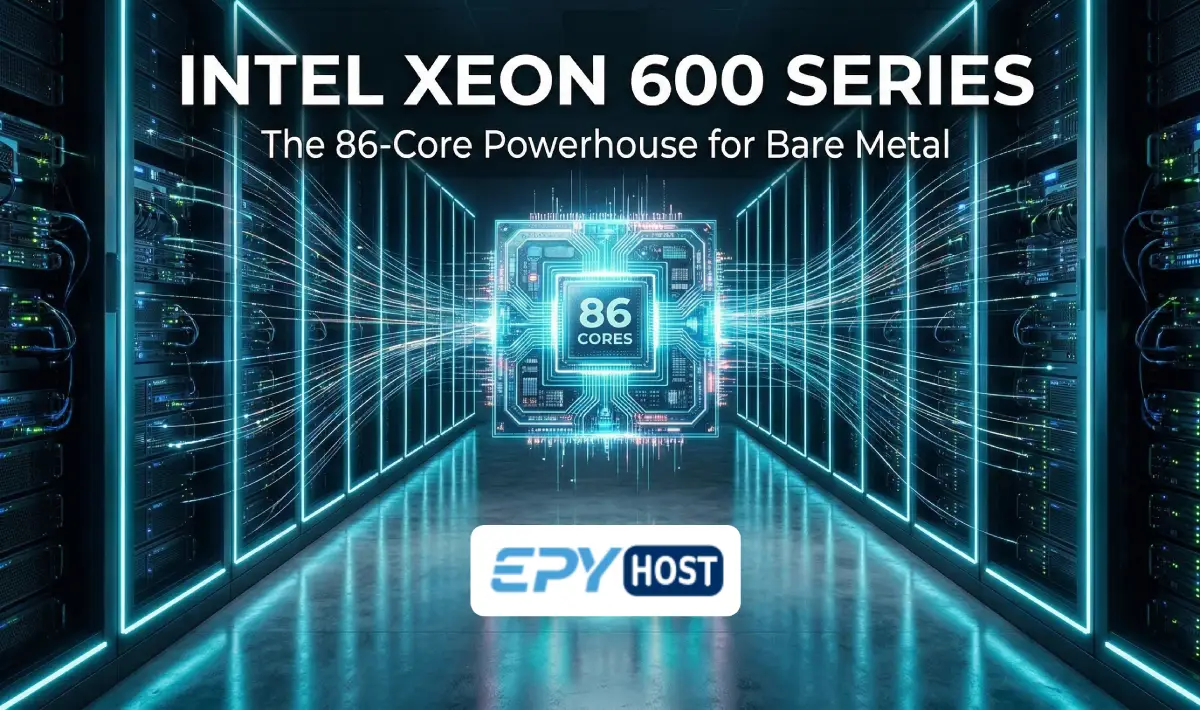
At the very top of this highly anticipated stack sits the flagship Intel Xeon 698X—an 86-core behemoth engineered specifically for high-frequency trading, massive database caching, 3D rendering, and complex scientific simulations.
For businesses relying on bare metal performance to drive their operations, understanding the tectonic shifts brought by Granite Rapids is essential. In this comprehensive breakdown, we will dissect the architecture of the new Xeon 600 series, explore the massive I/O capabilities of its 128 PCIe 5.0 lanes, explain how it shatters the memory bandwidth wall, and detail why this processor is the ultimate engine for your next EPY Host dedicated server.
The Era of Dual-Track Architecture
Before diving into the specifications of the Xeon 698X, it is crucial to understand how Intel has restructured its data center roadmap for 2026. Recognizing that cloud providers and enterprise businesses have vastly different needs, Intel split the Xeon 600 family into two distinct architectural tracks:
- Sierra Forest (E-Cores): Designed for extreme density and cloud-native environments. These processors utilize Efficiency Cores (E-cores) to pack hundreds of lightweight threads into a single socket, prioritizing power efficiency for microservices and basic web hosting.
- Granite Rapids (P-Cores): Designed for maximum per-core performance. These processors utilize heavy-duty Performance Cores (P-cores) to deliver the raw mathematical muscle required for AI inference, deep databases, rendering, and high-performance computing (HPC).
The Xeon 698X belongs firmly to the Granite Rapids track. It is not designed to sip power; it is designed to conquer the most demanding, latency-sensitive workloads in the world with absolute brute force.
The Heart of the Beast: Dissecting the Xeon 698X
At the center of Granite Rapids is an advanced chiplet-based architecture built on the cutting-edge Intel 3 (custom 5nm class) manufacturing process. Unlike monolithic dies of the past, Intel now utilizes advanced packaging to connect multiple compute tiles and I/O tiles, allowing for unprecedented scalability without sacrificing latency.
Core Count and Frequency Specifications
The flagship Xeon 698X boasts specifications that redefine single-socket capabilities:
- Cores: 86 pure Performance Cores (P-cores).
- Threads: 172 threads per socket (Intel Hyper-Threading is fully enabled).
- Base Clock: 2.0 GHz across all 86 cores.
- Max Turbo Boost: Up to an astonishing 4.8 GHz on select cores.
- L3 Cache: A massive 336 MB shared across the compute tiles.
What makes these numbers so impressive is the balance. Historically, pushing past 64 cores meant severely sacrificing clock speed to keep temperatures under control. Thanks to the highly efficient Redwood Cove core architecture and advanced power management, the Xeon 698X can still push nearly 5.0 GHz when a workload demands rapid, single-threaded execution.
This makes it exceptionally versatile. It can handle highly parallelized tasks (like rendering a massive 3D scene) across its 172 threads, but it will not bottleneck when running legacy enterprise software that relies heavily on fast single-core clock speeds.
Smashing the Bandwidth Wall with Advanced Memory
In the modern data center, processors are rarely bottlenecked by a lack of mathematical power. Instead, they suffer from "memory starvation"—the cores sit idle waiting for data to be retrieved from RAM. An 86-core processor can chew through data at an incomprehensible rate, meaning Intel had to completely redesign the memory controller for Granite Rapids.
The 8-Channel DDR5 Interface
The Xeon 698X features a massive eight-channel DDR5 memory interface. This allows the CPU to access a significantly wider physical pathway to the RAM modules compared to older generations.
- Standard Speed: Officially supports up to 6400 MT/s (MegaTransfers per second) standard DDR5 ECC memory.
- Maximum Capacity: Supports up to 4 TB of total memory per socket, making it a dream for in-memory databases like Redis, Memcached, or SAP HANA.
The Game-Changer: MCR DIMM Support
While 6400 MT/s is incredibly fast, Granite Rapids introduces native support for Multiplexed Combined Rank (MCR) DIMMs.
MCR DIMMs are a revolutionary new memory technology designed specifically for ultra-high-bandwidth server environments. Traditional DDR5 modules send data to the CPU one rank at a time. MCR DIMMs utilize a specialized buffer chip on the memory stick itself to multiplex two ranks of memory simultaneously, effectively doubling the data rate delivered to the processor.
By utilizing MCR DIMMs, the Xeon 698X can achieve memory speeds of up to 8000 MT/s, delivering a staggering aggregate memory bandwidth of over 409 GB/s. For simulation workloads, fluid dynamics, and complex financial modeling, this elimination of the memory bottleneck directly translates to faster time-to-insight.
PCIe 5.0 and the I/O Revolution
A dedicated server is an ecosystem. The CPU must communicate seamlessly with NVMe storage drives, network interface cards (NICs), and external hardware accelerators. To facilitate this, Intel equipped the Granite Rapids platform with a phenomenal amount of Input/Output bandwidth.
128 Lanes of PCIe Gen 5
The Xeon 698X provides an unmatched 128 lanes of native PCIe 5.0 connectivity directly from the CPU.
PCIe Gen 5 offers double the bandwidth of Gen 4, providing 32 GT/s (Gigatransfers per second) per lane. But why does a server need 128 lanes?
- Massive NVMe Storage Arrays: A single PCIe 5.0 x4 connection can push up to 14 GB/s of read/write speeds. With 128 lanes, an EPY Host bare metal server can theoretically support up to 32 blazing-fast PCIe Gen 5 NVMe drives directly attached to the CPU without relying on a slow PCIe switch. This is critical for high-frequency trading logs and massive video editing servers.
- Multi-GPU Configurations: If you are running AI inference or complex rendering workloads, you can slot multiple high-end accelerators (like NVIDIA or AMD Instinct GPUs) into the server, giving each card a full x16 Gen 5 connection. The CPU can feed data to the GPUs at 64 GB/s per slot, completely eliminating the PCIe bottleneck.
- 400G and 800G Networking: Modern data centers require immense network throughput. These lanes allow for the installation of multi-port 400 GbE SmartNICs and DPUs, ensuring your server can ingest and broadcast data at line rate without saturating the bus.
CXL 2.0 Integration
Alongside PCIe 5.0, the Granite Rapids platform natively supports Compute Express Link (CXL) 2.0. CXL is an open industry standard interconnect offering high-bandwidth, low-latency connectivity between the CPU and memory expanders or accelerators. CXL 2.0 allows for memory pooling, meaning your server can dynamically assign memory resources to accelerators on the fly, further maximizing the efficiency of your bare metal hardware.
Advanced Accelerators: Why AVX-512 Still Matters
One of Intel's greatest strengths in the enterprise market is their deep integration of hardware accelerators directly into the silicon. The Xeon 698X is not just a collection of generic cores; it features dedicated, built-in acceleration engines designed to handle specific, computationally expensive tasks.
The crown jewel of these instructions is Advanced Vector Extensions 512 (AVX-512).
While AVX-512 was controversially removed from Intel's consumer desktop chips, it remains fully enabled and optimized in the Xeon 600 series. The Xeon 698X features two AVX-512 FMA (Fused Multiply-Add) ports per core.
How AVX-512 Accelerates Your Workloads
Standard processor instructions process data one piece at a time. Vector instructions like AVX-512 allow the processor to apply a single mathematical operation to a massive set of data points simultaneously (up to 512 bits wide per clock cycle).
- Rendering and 3D Modeling: Ray tracing and fluid simulations rely heavily on floating-point vector math. AVX-512 allows software like Blender, Maya, and V-Ray to render frames significantly faster by calculating massive arrays of light bounces simultaneously.
- Cryptography and Security: Securing data in transit requires encrypting and decrypting packets at incredible speeds. AVX-512 heavily accelerates AES, SHA, and RSA algorithms, allowing your server to maintain a zero-trust security posture without bogging down the CPU cores.
- Scientific Simulation: For finite element analysis, genomic sequencing, and weather modeling, the ability to process 512 bits of floating-point data per cycle drastically reduces the time required to complete complex simulations.
In addition to AVX-512, Granite Rapids includes Intel AMX (Advanced Matrix Extensions), specifically designed to accelerate deep learning inference and training on the CPU, allowing businesses to run natural language processing (NLP) and recommendation engines without purchasing dedicated GPUs.
Thermal Realities: Cooling the 350W Giant
Extreme performance requires immense power. The Intel Xeon 698X operates with a baseline Thermal Design Power (TDP) of 350 Watts, and it can draw up to 420 Watts under maximum all-core turbo boost conditions.
Dissipating this amount of heat concentrated into a dual-die package requires serious infrastructure.
The LGA 4710 Socket
Intel designed the massive new Socket 4710 specifically for Granite Rapids to ensure robust power delivery. The physical size of the chip and the socket means that traditional, low-profile 1U server chassis simply cannot provide enough airflow to keep the Xeon 698X from thermal throttling under heavy load.
At EPY Host, we deploy Granite Rapids processors in specialized, high-airflow bare metal chassis. Whether utilizing aggressive high-RPM fan walls in larger 2U/4U rackmounts or implementing custom enterprise liquid cooling loops, we ensure that your Xeon 698X operates at its peak 4.8 GHz boost clock without encountering thermal degradation.
When you rent a high-TDP server, the quality of the data center facility matters just as much as the silicon itself.
Workload Matchmaking: Who Needs the Xeon 698X?
An 86-core, high-frequency dedicated server is a premium infrastructure asset. It is not designed for basic web hosting or simple file storage. The Xeon 600 series is built for enterprises that hit the absolute limits of standard computing.
You should consider deploying a Granite Rapids dedicated server if your business fits into any of the following categories:
- High-Frequency Trading (HFT) and Financial Modeling: The combination of 4.8 GHz single-core boost speeds (for rapid trade execution) and immense 8-channel DDR5 memory bandwidth (for analyzing massive historical datasets) makes the Xeon 698X the ultimate algorithmic trading engine.
- Enterprise Virtualization and VDI: If you need to host hundreds of high-performance virtual desktops for engineers and designers, the 172 threads and massive 4 TB memory capacity allow for extreme consolidation, lowering your per-user infrastructure cost.
- Media and Entertainment Rendering: Studios rendering high-resolution 4K/8K video or complex 3D VFX environments can leverage AVX-512 and massive core counts to drastically shrink rendering queue times.
- Heavy Database and Big Data Analytics: Relational databases (SQL) and massive NoSQL clusters thrive on fast PCIe storage and high core clocks. The 128 lanes of PCIe 5.0 ensure your NVMe storage arrays never become the bottleneck.
The Verdict: Intel's Aggressive Comeback
The release of the Granite Rapids Xeon 600 series proves that Intel is no longer resting on its legacy laurels. By delivering 86 blazing-fast P-cores, doubling the memory speed with MCR DIMMs, and providing a staggering 128 lanes of PCIe 5.0, they have engineered a processor that fundamentally changes what a single-socket server can achieve.
For organizations that demand the highest levels of single-thread performance combined with massive parallel throughput, the Xeon 698X is the uncontested champion of the 2026 enterprise market.
At EPY Host, we are proud to offer cutting-edge bare metal configurations featuring the newest Intel architectures. We understand that migrating to a new platform requires careful planning regarding memory topology, storage layout, and network configuration to truly unlock the CPU's potential.
 Recent Topics for you