The x86 dedicated server landscape in 2026 is defined by a single, undeniable reality: AMD is dictating the pace of innovation. For Chief Technology Officers, IT architects, and systems administrators, the days of a "one-size-fits-all" server processor are long gone. Today, server infrastructure is sharply bifurcating. On one end of the spectrum, there is a massive demand for ultra-efficient, highly dense processors designed for the edge, telecommunications, and power-constrained data centers. On the other extreme, the relentless surge of AI supercomputing demands colossal, liquid-cooled behemoths capable of feeding data to accelerators at unprecedented speeds.
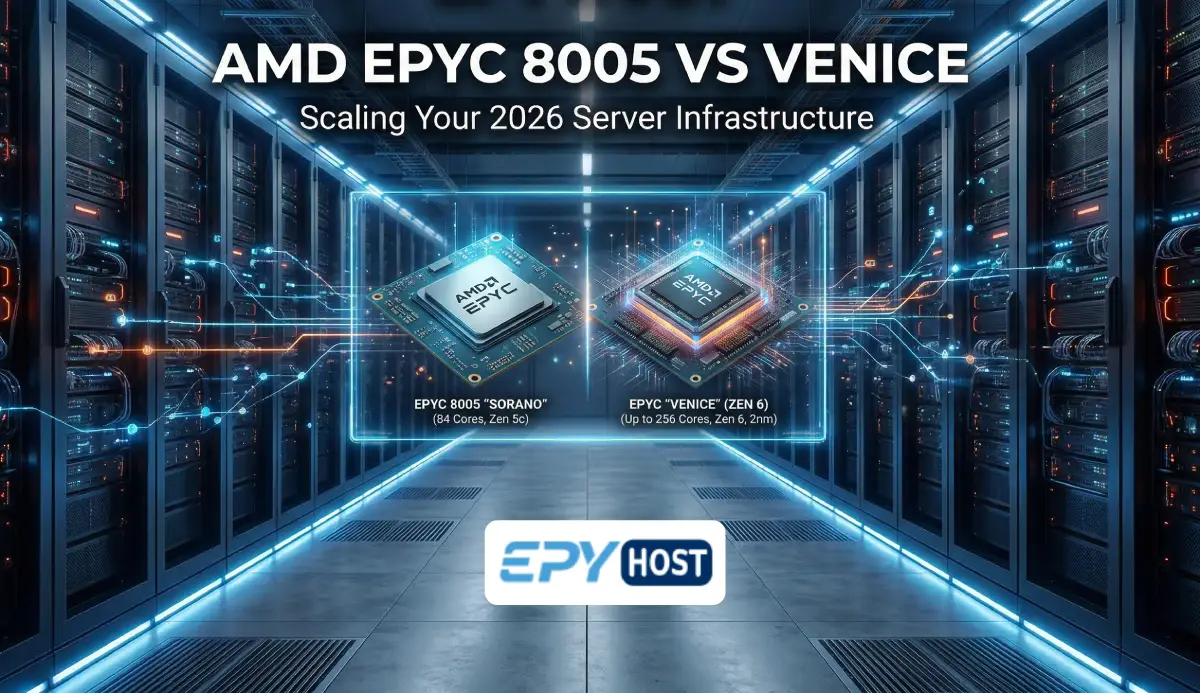
AMD has masterfully positioned itself to dominate both extremes. Early in 2026, the company quietly but powerfully launched the EPYC 8005 series (codenamed "Sorano"), targeting the hyper-efficient edge and single-socket deployment market. But looming just over the horizon for later this year is the true heavyweight: the 6th Generation EPYC series (codenamed "Venice"), built on the cutting-edge Zen 6 architecture.
If you are planning your bare metal deployments, hardware upgrades, or cloud infrastructure strategy for the next three years, understanding the vast architectural differences between Sorano and Venice is critical. In this comprehensive guide, we will dissect the newly released EPYC 8005 processors, preview the staggering technical specifications of the upcoming EPYC Venice CPUs, and provide a strategic roadmap to help you choose the right dedicated server infrastructure for your 2026 workloads.
The Current State of AMD Bare Metal in 2026
To understand where AMD is going, you have to look at how they segment their silicon. AMD no longer forces data centers to buy a 400-watt, dual-socket monster just to get high core counts. They have split their EPYC family into distinct branches:
- The Mainline (e.g., Turin): Standard Zen architectures for general-purpose enterprise computing.
- The Edge/Telco (e.g., Siena, Sorano): Lower-power, cost-effective, single-socket optimized chips utilizing dense "c" cores.
- The HPC/Cloud Native (e.g., Bergamo, Venice): Maximum core counts and massive memory bandwidth for hyperscalers and AI factories.
The introduction of Sorano and the imminent arrival of Venice represent the absolute pinnacles of the Edge and HPC branches, respectively. They are built on different manufacturing nodes, utilize different sockets, and are engineered to solve entirely different computing bottlenecks.
The Edge Champion: AMD EPYC 8005 "Sorano"
Launched in February 2026, the AMD EPYC 8005 series is the direct successor to the highly successful 8004 "Siena" lineup. Sorano is not designed to break synthetic benchmark world records; it is designed to break efficiency records. It is the ultimate processor for environments where power, cooling, and physical space are strictly limited.
Architectural Breakdown of Sorano
The EPYC 8005 series leverages AMD's Zen 5c architecture. The "c" stands for compact. By reducing the L3 cache per core and utilizing high-density design libraries, AMD manages to pack an extraordinary amount of compute into a very small footprint.
- Maximum Core Count: Up to 84 Zen 5c cores (168 threads) on a single socket.
- Power Envelope: A maximum Thermal Design Power (TDP) of just 225W.
- Target Environments: Telecommunications (vRAN), edge computing, retail data centers, and dense web hosting.
Why Sorano Matters for Dedicated Servers
For the vast majority of standard business applications, a 225W processor that delivers 84 cores is a game-changer. Historically, achieving an 84-core count required a massive dual-socket motherboard and over 500W of power, which significantly inflated the cost of power and cooling in a data center facility.
With Sorano, EPY Host can offer single-socket dedicated servers that punch well above their weight class. If you are running thousands of lightweight containers, hosting high-traffic WordPress multi-sites, or managing a fleet of virtual machines (VMs), the EPYC 8005 allows you to consolidate your workloads onto fewer physical machines without blowing up your electricity bill.
Furthermore, Sorano includes specific hardware-level optimizations for Low-Density Parity-Check (LDPC) calculations, making it an absolute powerhouse for networking and layer-1 telco processing.
The Behemoth on the Horizon: AMD EPYC "Venice" (Zen 6)
While Sorano is mastering the edge, AMD is preparing to rewrite the rules of the core data center. Expected to ramp up production in late 2026, the 6th Generation EPYC "Venice" processor is designed for one primary purpose: dominating the AI, cloud-native, and High-Performance Computing (HPC) landscape.
Venice represents a massive generational leap, abandoning incremental upgrades in favor of a total platform overhaul.
The Leap to TSMC 2nm and 256 Cores
The most staggering specification of the Venice architecture is its raw density. AMD is aggressively moving to TSMC's cutting-edge 2nm (N2) process node. This shrink in manufacturing geometry allows AMD to drastically increase transistor density while maintaining manageable power scaling.
- Maximum Core Count: Rumored to reach an astounding 256 Zen 6c cores (512 threads) per processor.
- Architecture: A fundamental ground-up redesign of the core, featuring an 8-wide execution pipeline to vastly improve single-thread Instructions Per Clock (IPC).
- Die Layout: Advanced packaging allows AMD to stack massive 32-core Core Complex Dies (CCDs) around a central I/O die, breaking previous physical size limitations.
To put this in perspective, a dual-socket Venice dedicated server will provide a single operating system with 512 physical cores and 1,024 threads. This is the density required to run massive, concurrent database queries and real-time AI inference at the rack level.
The All-New SP7 Platform
You cannot feed 256 cores using last year's motherboard technology. Venice will introduce the massive new SP7 socket. This platform change is necessary because the processor requires a profound increase in power delivery and physical pins to support next-generation memory and input/output (I/O).
Breaking Bottlenecks: 16-Channel Memory and PCIe 6.0
A processor with 256 cores will spend most of its time sitting idle if it cannot retrieve data fast enough. "Memory starvation" is the primary enemy of modern AI and database workloads. AMD engineered the Venice/SP7 platform specifically to shatter these bottlenecks.
The Transition to 16-Channel DDR5
Current-generation high-end servers top out at 12 memory channels. Venice expands this to 16 channels of DDR5 memory, with support for advanced modules like MR-DIMM (Multiplexed Rank DIMM).
- The Result: Memory bandwidth is expected to push up to 1.6 TB/s.
- The Impact: Large Language Models (LLMs) and massive in-memory databases (like SAP HANA or Redis clusters) require data to be shuttled from RAM to the CPU instantaneously. By widening the memory highway to 16 lanes, Venice ensures that all 256 cores are constantly fed, drastically reducing latency for data-heavy applications.
Pioneering PCIe 6.0
Venice is slated to be one of the first major enterprise platforms to natively support PCIe 6.0.
- The Bandwidth Double: PCIe 6.0 utilizes PAM4 signaling to double the bandwidth of PCIe 5.0, delivering up to 128 GT/s per pin.
- The Impact: This is not about making your graphics card slightly faster. In the server world, PCIe 6.0 is about connecting massive pools of NVMe storage and linking next-generation AI accelerators (like the AMD Instinct MI400 or NVIDIA Rubin GPUs) to the CPU. With PCIe 6.0, a Venice dedicated server can shuttle data from solid-state storage directly into the GPU's memory with almost zero latency, making it the perfect "head node" for an AI supercluster.
Thermal Realities: Air Cooling vs. Liquid Cooling
The architectural divergence between Sorano and Venice also forces a divergence in how data centers are built and managed.
- The Sorano Advantage: Because the EPYC 8005 series operates within a 225W power envelope, it can be comfortably cooled using traditional data center air cooling. You can easily deploy a 1U or 2U Sorano dedicated server into a standard colocation rack without worrying about thermal throttling. This makes deployment cheap, fast, and highly reliable.
- The Venice Challenge: You cannot cram 256 cores running at high frequencies onto a 2nm node without generating immense, concentrated heat. While official TDP numbers for the top-tier Venice chips are not finalized, industry consensus points to a power draw that will easily exceed 500W to 600W per socket.
Dual-socket Venice servers will push the physical limits of traditional forced-air cooling. To fully utilize these machines without thermal degradation, facilities will increasingly need to rely on Direct-to-Chip (DTC) liquid cooling or massive, specialized 4U chassis with extreme-RPM fan walls. This is why partnering with an advanced infrastructure provider is critical when scaling to Zen 6.
Sorano vs. Venice: The Architectural Comparison Matrix
To summarize the vast differences in AMD's 2026 lineup, here is how the two architectures stack up against each other:
| Feature | AMD EPYC 8005 "Sorano" | Upcoming AMD EPYC "Venice" |
|---|---|---|
| Release Timeline | Q1 2026 (Available Now) | Expected Q4 2026 / Early 2027 |
| Architecture | Zen 5c (Compact) | Zen 6 / Zen 6c |
| Manufacturing Node | TSMC 4nm/3nm class | TSMC 2nm (N2) |
| Max Core Count | 84 Cores | Up to 256 Cores |
| Socket | SP6 (Successor/Variant) | SP7 (All-new) |
| Memory Support | Up to 6-Channel DDR5 | Up to 16-Channel DDR5 |
| PCIe Generation | PCIe 5.0 | PCIe 6.0 |
| Max TDP (Estimated) | 225W | 500W - 600W+ |
| Primary Use Case | Edge, vRAN, Budget Hosting | AI, Cloud-Native, HPC |
Strategic Note: Do not view Venice as the "replacement" for Sorano. They are parallel tracks. If you buy a Sorano server today, it will not be obsolete when Venice launches, because a Venice server will cost significantly more to power, cool, and lease.
Formulating Your 2026 Bare Metal Strategy
How do you translate these hardware specifications into a business decision? Choosing between high-efficiency computing and high-performance computing comes down to analyzing your specific workloads.
When to Deploy EPYC 8005 "Sorano" Dedicated Servers
You should actively migrate to Sorano-based infrastructure right now if your business model relies on:
- Virtualization and VPS Hosting: If you are a hosting provider or an enterprise running Proxmox, VMware, or KVM, Sorano gives you 84 physical cores to carve up. You can host dozens of high-performance VMs on a single, low-power machine, drastically improving your profit margins.
- Edge Computing: If you need to deploy servers close to the end-user (e.g., in regional data centers rather than massive central hubs) for IoT data processing or content delivery networks (CDNs).
- Strict Budget Constraints: If you need a massive upgrade in core count but cannot justify the steep premium of renting dual-socket, 500W data center nodes.
When to Wait for EPYC "Venice" (Zen 6) Dedicated Servers
You should begin planning your budget and facility strategy for Venice if your roadmap involves:
- Agentic AI and Machine Learning: If your business is training models or running complex, multi-agent AI inference workflows. Venice's PCIe 6.0 lanes are mandatory for preventing your expensive GPUs from idling.
- Massive In-Memory Analytics: If you are running financial modeling, genomic sequencing, or massive SQL/NoSQL databases that require hundreds of gigabytes of data to be processed simultaneously. The 16-channel memory bandwidth of Venice will fundamentally change how fast your queries resolve.
- Ultimate High-Density Consolidation: If your goal is to take an entire rack of older (Zen 2 or Zen 3) servers and compress that entire workload into a single, dual-socket 512-core Venice machine to save on rack space licensing.
Next-Generation Infrastructure with EPY Host
The evolution of server hardware is accelerating. The leap from Zen 5c to Zen 6 represents one of the largest single-generation jumps in core density and memory bandwidth in the history of the x86 architecture.
However, raw hardware is only as good as the network and facility it lives in. Deploying high-core-count, high-TDP servers requires a provider with advanced power delivery, enterprise-grade cooling, and a massive network backbone to handle the I/O these chips generate.
At EPY Host, we are continually expanding our hardware portfolio to ensure our clients have access to the exact compute profile their business demands—whether that is the hyper-efficient Sorano for edge deployments or the massive bandwidth of upcoming AI-ready platforms. We specialize in custom bare-metal configurations, ensuring that your processor, NVMe storage, and RAM are perfectly balanced to eliminate bottlenecks.
 Recent Topics for you