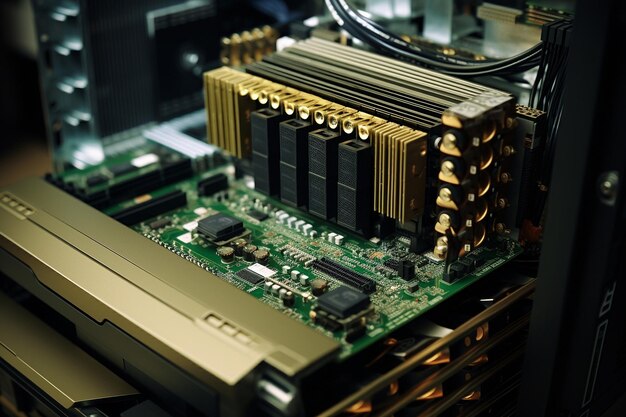
The AI landscape is undergoing a massive tectonic shift in 2026. The conversation has officially moved past basic generative text and image models. Today, the enterprise focus is locked entirely on Agentic AI—autonomous systems capable of reasoning, breaking down complex workflows, and communicating seamlessly with other AI agents to execute multi-step tasks without human intervention.
To power this next frontier, NVIDIA unveiled the Vera Rubin platform at GTC 2026. Named after the trailblazing astrophysicist Vera Florence Cooper Rubin, this new architecture represents a fundamental pivot in how we think about dedicated servers. We are no longer talking about slotting discrete graphics cards into standard x86 servers. We are talking about rack-scale, liquid-cooled "AI factories" built from the ground up to conquer the massive computational and memory demands of trillion-parameter models.
At the beating heart of this new ecosystem is the NVIDIA Vera CPU, a processor purpose-built to orchestrate the chaos of continuous AI reasoning. In this comprehensive guide, we will break down the technological marvels of the Vera Rubin platform, explore the staggering specifications of the 88-core Vera CPU, examine the NVL72 rack architecture, and explain why this liquid-cooled behemoth is the new gold standard for AI dedicated servers.
The Paradigm Shift: Why Agentic AI Demands New Hardware
Before diving into the silicon, it is critical to understand the software problem NVIDIA is solving. The previous generation of AI infrastructure—including the mighty Hopper and Blackwell architectures—was primarily designed to handle massive parallel processing for model training and basic inference.
Agentic AI changes the math. When an autonomous AI agent is assigned a goal, it must continuously reason, access tools, query databases, and spawn sub-agents. This creates a highly dynamic workload characterized by:
- Massive Context Windows: Agents need to "remember" long histories of actions and documents, requiring immense, high-bandwidth memory.
- Constant Context Switching: Processors must rapidly shift between different tasks, from compiling code to querying search engines.
- CPU-to-GPU Bottlenecks: Traditional servers bottleneck when shuttling data between general-purpose x86 CPUs and AI accelerators over standard PCIe lanes.
General-purpose data center CPUs were simply not built for the extreme utilization conditions of reinforcement learning and agentic workflows. NVIDIA realized that to achieve the next leap in performance, they had to design a central processor specifically tailored for the AI factory. Enter the Vera CPU.
Deep Dive: The 88-Core NVIDIA Vera CPU
The NVIDIA Vera CPU elevates the processor from a supporting role to a core enabler of AI efficiency. Rather than relying on standard x86 architecture, NVIDIA designed a custom ARM-based powerhouse optimized explicitly for data processing, orchestration, and agentic inference.
The "Olympus" Core Architecture
At the core of the Vera CPU are 88 custom-designed NVIDIA "Olympus" cores. These are fully ARM-compatible but engineered in-house to deliver extraordinary single-thread performance. The Olympus core features a 10-wide instruction fetch and decode front-end, designed specifically to accelerate compilers, runtime engines, and the complex analytics pipelines required by autonomous agents.
To maximize throughput in multi-tenant environments, Vera utilizes NVIDIA Spatial Multithreading, allowing each CPU to handle up to 176 threads simultaneously. This ensures consistent, predictable performance even when an AI factory is running tens of thousands of concurrent jobs.
Shattering the Memory Bottleneck
Raw compute power is useless if you cannot feed data to the cores fast enough. To address this, NVIDIA equipped the Vera CPU with a staggering memory subsystem.
- Memory Type: LPDDR5X (Low-Power Double Data Rate 5X).
- Capacity: Up to 1.5 TB per CPU.
- Bandwidth: Up to 1.2 TB/s.
By utilizing LPDDR5X, Vera delivers 2.4x higher memory bandwidth and 3x greater capacity than its predecessor, the Grace CPU, all while maintaining a remarkably low power profile. This massive memory pool allows the CPU to hold vast amounts of context data in reserve, preventing the GPU from stalling while waiting for information.
Efficiency and Performance Metrics
The results of this architectural focus are striking. According to early 2026 benchmarks, the Vera CPU delivers:
- 50% Faster Performance: Compared to traditional rack-scale CPUs in compilation, scripting, and agentic sandbox environments.
- 2x Greater Energy Efficiency: Delivering massive throughput at a fraction of the power cost of standard enterprise processors.
The Rubin GPU: Pushing the Limits of Physics
While the Vera CPU handles the orchestration, the NVIDIA Rubin GPU provides the brute-force mathematical muscle. Built by TSMC on a cutting-edge 3nm process, the Rubin GPU is a ~336-billion transistor monster designed specifically for massive-scale Mixture-of-Experts (MoE) models.
The Leap to HBM4 Memory
The most significant upgrade in the Rubin GPU is the transition to High Bandwidth Memory 4 (HBM4). Data movement to and from accelerators has historically been the biggest constraint in AI workloads. HBM4 shatters this ceiling.
- Capacity per GPU: Up to 288 GB of HBM4.
- Memory Bandwidth: An astonishing 22.2 TB/s.
This leap in memory bandwidth directly addresses the "memory wall" that plagues long-context AI inference, keeping execution pipelines fed under extremely heavy loads.
Compute and Power Specifications
The Rubin GPU is built for speed, boasting up to 50 PFLOPS of NVFP4 inference and 35 PFLOPS for training. However, this extreme performance comes with a significant thermal cost.
The Thermal Design Power (TDP) of a single Rubin GPU sits at an estimated 2.3 kW. This massive power draw is exactly why traditional 1U and 2U server form factors are becoming obsolete for frontier AI. You cannot simply drop a 2.3 kW chip into a standard air-cooled chassis and expect it to survive.
The NVL72 Rack: The True Unit of the AI Factory
With the Vera Rubin platform, NVIDIA has made it clear that the individual server is no longer the fundamental unit of computing. The rack is the new server. The flagship deployment model for this generation is the NVIDIA Vera Rubin NVL72. This is not a collection of individual machines wired together; it is a single, unified rack-scale supercomputer designed to operate as one massive accelerator.
Architecture of the NVL72
A fully populated NVL72 rack integrates:
- 72 NVIDIA Rubin GPUs
- 36 NVIDIA Vera CPUs
The NVLink 6 Interconnect Fabric
To make these 108 distinct processors act as a single brain, NVIDIA deployed their 6th generation NVLink fabric. The bandwidth numbers here are difficult to comprehend by traditional networking standards:
- GPU-to-GPU (NVLink 6): 3.6 TB/s of bidirectional bandwidth per GPU.
- CPU-to-GPU (NVLink-C2C): 1.8 TB/s of coherent bandwidth, allowing the Vera CPU and Rubin GPU to share memory seamlessly without traditional PCIe bottlenecks.
- Rack-Scale Aggregate Bandwidth: 260 TB/s across the entire NVL72 chassis.
The Economic Impact: 10x Lower Token Costs
By tightly co-designing the Vera CPU, Rubin GPU, and NVLink fabric, NVIDIA has achieved a massive reduction in the cost of running AI. The NVL72 platform targets up to a 10x reduction in inference token cost compared to the Blackwell generation. For training complex Mixture-of-Experts models, it requires 4x fewer GPUs to achieve equivalent performance.
For enterprises deploying dedicated servers, this means that while the upfront infrastructure cost of a Vera Rubin rack is immense, the actual operational cost of generating intelligence drops significantly.
Expanding the Ecosystem: Scale-Out Networking
An AI factory rarely consists of just one rack. To scale intelligence across multiple NVL72 pods, NVIDIA introduced a suite of new networking silicon designed to accelerate east-west traffic (server-to-server communication).
- ConnectX-9 SuperNIC: Delivering up to 1.6 Tb/s of high-throughput, low-latency data transfer per endpoint.
- BlueField-4 DPU (Data Processing Unit): Featuring 64 ARM Neoverse V2 cores, the BlueField-4 offloads massive infrastructure tasks—like storage routing, KV cache management, and zero-trust security encryption—away from the Vera CPU, ensuring all compute power is reserved for AI workloads.
- Spectrum-6 Ethernet: A 102.4 Tb/s switch infrastructure utilizing co-packaged optics (silicon photonics) to reduce power consumption and increase resiliency across the data center.
Comparing the Generations: Grace vs. Vera
To truly appreciate the leap forward, it is helpful to look at how the Vera CPU stacks up against its direct predecessor, the Grace CPU.
| Feature | NVIDIA Grace CPU | NVIDIA Vera CPU |
|---|---|---|
| Core Architecture | 72 ARM Neoverse V2 Cores | 88 Custom NVIDIA Olympus Cores |
| Total Threads | 72 | 176 (Spatial Multithreading) |
| L3 Cache | 114 MB | 162 MB |
| Memory Bandwidth | Up to 512 GB/s | Up to 1.2 TB/s |
| Memory Capacity | Up to 480 GB LPDDR5X | Up to 1.5 TB LPDDR5X |
| CPU-to-GPU Link | 900 GB/s | 1.8 TB/s (NVLink-C2C) |
Note: The doubling of the CPU-to-GPU link bandwidth is perhaps the most critical upgrade for Agentic AI, as it allows the CPU to rapidly feed complex contextual data into the GPU's memory pool without stalling the execution pipeline.
The End of Air Cooling: Why Liquid is Mandatory
If you are planning your dedicated server infrastructure roadmap for 2026 and beyond, there is one inescapable reality: air cooling is dead in the high-end AI space.
When you combine 72 Rubin GPUs (at 2.3 kW each), 36 Vera CPUs, NVLink switches, and high-speed networking gear, a single NVL72 rack can easily draw north of 120 kW of power, with some dense configurations pushing significantly higher. Blowing cold air across heat sinks is physically incapable of dissipating this level of thermal density. To operate the Vera Rubin platform, data centers must implement advanced Direct-to-Chip (DTC) liquid cooling.
How Direct-to-Chip Cooling Works in the NVL72
In a liquid-cooled Vera Rubin rack, cold plates are mounted directly flush against the Vera CPUs, Rubin GPUs, and NVLink switches. A closed-loop system pumps specially formulated coolant directly over these high-heat components. The liquid absorbs the thermal energy instantly and carries it away to an in-rack or in-row Coolant Distribution Unit (CDU), which then transfers the heat to the facility's broader water loop.
This transition requires a massive overhaul of data center plumbing, power delivery, and floor loading capabilities. It is why partnering with a forward-thinking bare metal provider is more critical than ever. Attempting to retrofit legacy air-cooled data centers for Vera Rubin is an engineering nightmare; you need facilities explicitly designed for the extreme power and thermal demands of the AI factory era.
What This Means for Dedicated Server Infrastructure
For Chief Technology Officers, IT Directors, and AI developers, the release of the Vera Rubin platform forces a strategic re-evaluation of how you procure and deploy compute.
- The Rise of Bare Metal Pods: Renting a single 2U server with a couple of GPUs is still viable for basic web hosting and small-scale fine-tuning. However, to compete in the Agentic AI space, businesses will increasingly need to lease entire rack-scale pods. Dedicated server providers must evolve to offer isolated, secure, multi-rack environments connected via InfiniBand or Spectrum-X Ethernet.
- Software-Defined Infrastructure: Managing an NVL72 rack requires sophisticated orchestration. Tools like NVIDIA Mission Control and the BlueField-4 DPU allow for bare-metal infrastructure to be dynamically provisioned, monitored, and secured with cloud-like agility, but without the virtualization overhead.
- The Importance of AI-Native Storage: With GPUs capable of processing data at 22 TB/s, traditional storage arrays will choke the system. Deployments will require advanced Context Memory Storage platforms leveraging NVMe-over-Fabrics to ensure the Vera CPUs and Rubin GPUs are never waiting on disk reads.
At EPY Host, we are continually evolving our infrastructure to meet the bleeding edge of enterprise technology. As the industry transitions into the Vera Rubin era, securing highly available, power-dense, and liquid-cooled environments will be the ultimate competitive advantage for AI-driven businesses.
Securing Your AI Future
The NVIDIA Vera CPU and Rubin GPU represent the most aggressive leap in computing power the data center industry has ever seen. By moving away from generic architectures and building bespoke silicon for Agentic AI, NVIDIA has provided the blueprint for the next decade of autonomous intelligence.
As models grow larger and agents become more complex, relying on outdated hardware will quickly price you out of the market via inefficient token generation costs. The future belongs to those who deploy purpose-built AI factories.
Would you like me to explore our current high-performance dedicated server options at EPY Host?
 Recent Topics for you