For the past several years, the tech industry's obsession with artificial intelligence was largely confined to "generative" models. We typed a prompt, the server processed the request, and a few seconds later, it spit out text, an image, or code. It was a linear, start-and-stop computational process.
In 2026, that paradigm is officially obsolete. The enterprise world has rapidly shifted its focus to Agentic AI.
Unlike a standard chatbot, an AI agent is autonomous. You give it a high-level goal (e.g., "Analyze our Q3 supply chain data, find the bottlenecks, email the vendors for updated pricing, and rewrite the logistics software module to compensate"). The agent then breaks that goal into smaller tasks, writes its own code, queries external databases, spawns sub-agents, and continuously loops through reasoning phases until the job is done.
From a software developer's perspective, this is a miracle of modern computer science. From an IT infrastructure perspective, it is an absolute nightmare.
Building the foundation for autonomous intelligence requires much more than just slapping a few high-end GPUs into a chassis. It requires a fundamental rethinking of how servers handle data flow. In this comprehensive guide, we will step away from the CPU and GPU brand wars to explore the holistic server requirements for Agentic AI hosting. We will break down why your legacy architecture will choke on autonomous workflows, and how to architect the ultimate Agentic AI dedicated servers using ultra-fast NVMe storage, CXL memory pooling, and extreme high-bandwidth networking.
The Paradigm Shift: Why Agentic AI Breaks Traditional Servers
To understand how to build AI workflow infrastructure, we first need to look at how an autonomous agent actually operates at the hardware level.
In a traditional web application or simple LLM inference model, the flow of data is predictable. A request comes into the CPU via the network interface card (NIC); the CPU pulls relevant data from the storage drive into the system memory (RAM); the CPU (or GPU) processes it, and the answer is sent back out.
Agentic AI operates in continuous, dynamic loops. An agent might need to instantly recall a massive contextual history, pause to retrieve three terabytes of vector data from an external database, run a massive parallel simulation, and communicate with ten other server nodes simultaneously.
This creates three massive bottlenecks in traditional bare metal servers:
- The Memory Wall: Agents require massive "context windows" to remember what they are doing. Traditional servers are hard-capped by the physical RAM slots on the motherboard.
- The Storage Choke: Agents heavily utilize Retrieval-Augmented Generation (RAG) to pull real-time facts from databases. Standard SSDs and legacy storage controllers cannot feed data to the processors fast enough, causing expensive GPUs to sit completely idle.
- The Network Traffic Jam: Multi-agent systems require constant machine-to-machine (East-West) communication. Standard 10G or even 100G networking creates latency spikes that derail real-time AI reasoning.
To build an infrastructure capable of supporting true Agentic AI, data center architects must solve these three bottlenecks using the latest 2026 enterprise technologies.
1. Shattering the Memory Wall: The Rise of CXL Pooling
Historically, if an AI application ran out of system memory, the server would start "swapping" data to the storage drive—a process so slow that it would immediately crash an agentic workflow. Alternatively, you had to over-provision your servers, buying massive amounts of expensive RAM for every single node, even if that memory was only utilized 20% of the time.
In the era of Agentic AI, the solution is Compute Express Link (CXL).
CXL (specifically CXL 2.0 and the emerging 3.0 standard) is a revolutionary open-industry interconnect built on top of the physical PCIe 5.0 and PCIe 6.0 interfaces. It allows for cache-coherent communication between the CPU, memory expanders, and smart accelerators.
How CXL Memory Pooling Works
Instead of trapping RAM inside an individual server, CXL allows you to create an external, independent pool of memory that sits on the network.
Imagine a massive chassis filled with nothing but terabytes of DDR5 memory. Through a CXL fabric switch, multiple dedicated servers can access this memory pool as if it were plugged directly into their own motherboards.
- Dynamic Allocation: If Agent A suddenly needs to process a massive multi-modal document (text, video, and audio), the CXL fabric can dynamically allocate 2 TB of memory to Agent A's server node in milliseconds.
- Cache Coherency: Because CXL is cache-coherent, the CPU and external accelerators (like GPUs or DPUs) can share the same memory space without having to constantly copy data back and forth, drastically reducing latency.
- Cost Efficiency: For enterprises scaling Agentic AI dedicated servers, CXL memory pooling means you no longer have to pay for stranded, unused memory trapped inside idle servers. You buy exactly what the cluster needs and allocate it dynamically.
If your 2026 server roadmap does not include CXL-capable processors (like Intel Granite Rapids or AMD Venice), your AI agents will inevitably hit a memory wall that severely limits their reasoning capabilities.
2. Eliminating the Storage Choke: NVMe-oF and AI-Native Filesystems
When an AI agent is tasked with writing a financial report, it doesn't just "guess" the numbers. It utilizes RAG (Retrieval-Augmented Generation) to scan millions of internal company documents, transaction logs, and real-time market feeds.
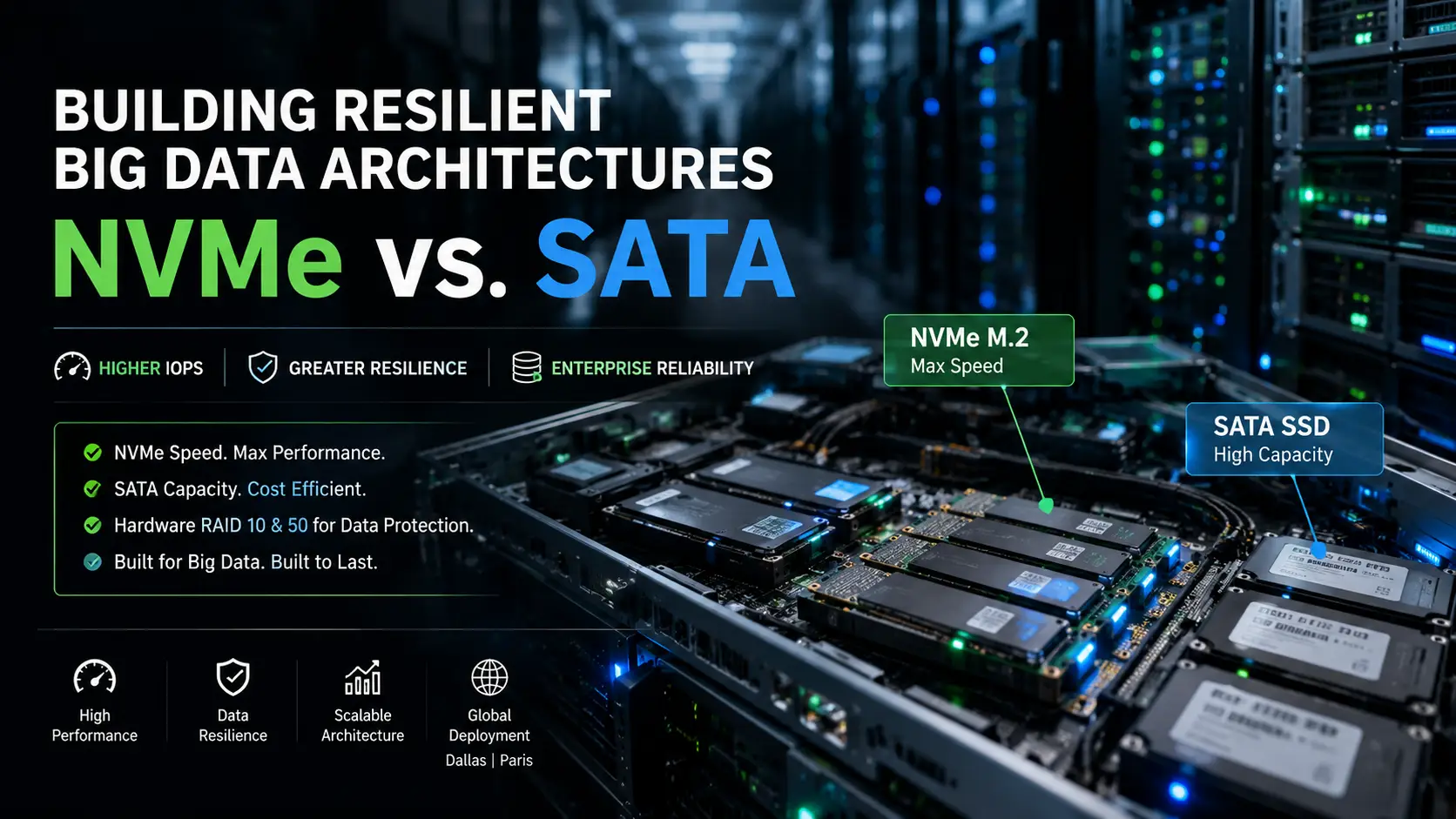
This requires the server to execute billions of vector database lookups every second. A standard SATA solid-state drive, or even a locally attached Gen 4 NVMe drive relying on legacy software stacks, will instantly buckle under this IOPS (Input/Output Operations Per Second) pressure.
The Power of NVMe over Fabrics (NVMe-oF)
To feed the beast, Agentic AI hosting requires NVMe over Fabrics (NVMe-oF). NVMe-oF is a protocol specification designed to connect hosts to high-speed storage across a network fabric (like Ethernet, Fibre Channel, or InfiniBand) without losing the blinding speed of local NVMe.
By utilizing NVMe-oF with RDMA (Remote Direct Memory Access), the storage data completely bypasses the traditional CPU networking stack. The data travels directly from the networked storage array straight into the GPU's memory.
- Zero CPU Bottlenecks: The server's main CPU is no longer burdened with handling storage interrupts, leaving 100% of its compute power dedicated to orchestrating the AI agent's logic.
- Massive Throughput: Utilizing PCIe Gen 5 NVMe drives in a JBOF (Just a Bunch of Flash) array connected via NVMe-oF allows a single bare metal server to ingest data at speeds exceeding 100 GB/s.
AI-Native Parallel Filesystems
Raw hardware is only half the battle. Standard file systems (like ext4 or NTFS) are not designed to handle the billions of tiny metadata requests generated by multi-agent swarms.
To fully utilize an NVMe-oF array, modern AI deployments require advanced parallel file systems (like optimized versions of Lustre, WEKA, or DAOS). These file systems distribute data across multiple storage nodes, ensuring that when an entire swarm of 500 AI agents simultaneously asks for different pieces of the same database, there is zero storage queueing delay.
3. The Network is the Computer: 400G/800G and NVLink 6
Perhaps the biggest misconception about AI infrastructure is that the GPU is the most important component. In reality, once you scale past a single machine, high-bandwidth server networking becomes the ultimate dictator of performance.
When an autonomous agent realizes a task is too complex for one node, it divides the workload across a cluster. This means massive neural network weights, KV caches (Key-Value caches used for agent memory), and intermediate calculation states must be constantly shuffled between servers.
If the network is slow, the GPUs sit idle. At $30,000+ per GPU, idle time is financial ruin for an enterprise. To prevent this, data centers are transitioning to extreme networking architectures.
The Backend: NVLink 6 and InfiniBand
For the absolute highest-tier AI factories, standard Ethernet is completely removed from the compute cluster.
- NVLink 6: Inside platforms like the NVIDIA NVL72, GPUs communicate over the NVLink 6 fabric, pushing an incomprehensible 3.6 TB/s of bidirectional bandwidth per GPU. This allows 72 GPUs to act mathematically as one single, massive processor.
- InfiniBand (NDR/XDR): To connect multiple racks together, AI clusters have historically relied on InfiniBand. Operating at 400G (NDR) and pushing toward 800G (XDR), InfiniBand provides ultra-low latency and lossless packet delivery, ensuring that distributed agents stay perfectly synchronized.
The Ethernet Revolution: Spectrum-6 and Ultra Ethernet
However, InfiniBand is notoriously expensive and difficult to manage for traditional enterprise IT teams. In 2026, we are seeing a massive shift toward highly optimized, AI-ready Ethernet fabrics, championed by the Ultra Ethernet Consortium (UEC) and hardware like NVIDIA Spectrum-6.
Spectrum-6 switches are built specifically for the erratic, bursty traffic patterns of AI workloads. Operating at 800G per port (with an aggregate switch capacity of 51.2 Tb/s), these next-generation Ethernet fabrics use advanced telemetry and adaptive routing.
If an AI agent sends a massive burst of data that threatens to cause a network collision, the Spectrum-6 switch can dynamically slice the data into smaller pieces and route them across multiple different network paths simultaneously, reassembling them at the destination with near-zero latency. This gives enterprises InfiniBand-like performance using standard, widely understood Ethernet topologies.
The Role of the DPU (Data Processing Unit)
You cannot push 400G or 800G of traffic through a server without melting the main CPU. To handle this massive data firehose, modern bare metal servers require a DPU (like the NVIDIA BlueField-3 or BlueField-4) or an advanced SmartNIC.
The DPU acts as a dedicated traffic cop. It sits on the network interface and completely offloads infrastructure tasks—like zero-trust security encryption, network routing, and storage management—away from the CPU. This ensures that 100% of your expensive server compute is dedicated to running the Agentic AI, rather than managing the overhead of the server itself.
4. Putting It Together: The Agentic Bare Metal Blueprint
If you are a CTO or Lead Architect tasked with building the infrastructure for your company's foray into Agentic AI, you can no longer buy servers like line items on a spreadsheet. You are not buying a "server"; you are architecting an "AI pod."
When you provision an Agentic AI dedicated server environment at EPY Host, here is what the blueprint for a next-generation deployment looks like:
- The Compute Layer: Dual-socket servers featuring high-core-count processors (like AMD EPYC Venice or Intel Xeon Granite Rapids) equipped with PCIe 6.0 and CXL support, paired with next-generation accelerators optimized for massive context windows (like NVIDIA Rubin or AMD Instinct MI400X).
- The Memory Layer: High-speed DDR5 memory integrated with MCR DIMMs, expanded by a CXL-attached memory pool to provide dynamic, cache-coherent RAM allocation for your most memory-hungry autonomous agents.
- The Storage Layer: Disaggregated, pure-NVMe storage arrays connected via NVMe-oF and managed by a parallel file system, bypassing the CPU to feed data directly into the GPU memory via GPUDirect Storage.
- The Networking Layer: A dual-plane network architecture. A standard 25G/100G front-end network for management and API access, paired with a massive 400G/800G backend compute fabric (powered by Spectrum-X Ethernet or InfiniBand) and managed by onboard DPUs.
- The Thermal Layer: Because this density generates extreme heat, the entire pod is housed in a facility engineered for Direct-to-Chip (D2C) liquid cooling or full-rack immersion cooling to prevent thermal throttling.
Evolving Your Infrastructure with EPY Host
The transition from generative text to autonomous, agentic workflows represents the most significant computing leap of the decade. As software developers push the boundaries of what AI agents can do independently, the underlying hardware must rise to the challenge. Attempting to run multi-agent systems on disjointed, legacy hardware will only result in massive latency, idle GPUs, and failed deployments.
To succeed in this new era, enterprises need cohesive, high-bandwidth, and strictly optimized environments. At EPY Host, we specialize in providing the heavy-duty bare metal infrastructure required to bring your AI initiatives to life. From extreme-density networking to advanced storage fabrics, we architect environments that ensure your agents never wait on hardware.
 Recent Topics for you